Sick Days and Flooded Floors: Why Health and Housing Define Survival in Mathare
- Shreyas Bulusu
- Jun 12
- 3 min read

When we talk about community development, we often look straight at income. We ask, “How can we help people earn?” But from what we share with the Light and Hope Initiative (LAHI) team, in Mathare, I’ve learned that economic empowerment is only half the battle. The other half is protecting those gains from the twin realities that threaten our community every single day: fragile health and fragile housing.

When you live in Mathare, the margin for error is razor-thin. A single bout of severe illness or a heavy downpour doesn't just disrupt a day---it can derail a life.
The Cost of Getting Sick
Imagine waking up with a burning fever, severe joint pain, or watching your child struggle to breathe. In many places, you visit a nearby clinic, get a prescription, and rest. In Mathare, getting seriously sick triggers a stressful calculations game.
While there are local dispensaries, they are often under-resourced, facing constant shortages of essential medicines. If you need specialized care or emergency treatment, the nearest public hospitals are far, plagued by long lines, and require upfront costs that many simply do not have. Too often, families are forced to make an impossible choice: buy food for the week, or buy the antibiotics that will cure an infection.
The Invisible Toll: Beyond malaria, waterborne diseases, and respiratory infections from cooking smoke, there is a quiet crisis of mental health. The psychological weight of chronic financial stress and a sense of invisibility takes a heavy toll, yet it is rarely openly discussed. It is carried silently.
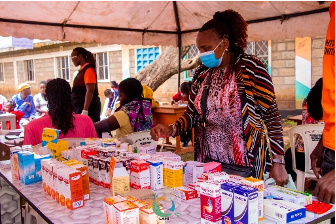

During our recent Medical Camp, we met Agnes an elderly resident who had been suffering from crippling arthritis for months, unable to afford the specialized injections (which cost around ksh15,000/116 US dollars) needed to walk without agony. Her grandchildren were missing school just to help her move around her home. Most families in Mathare are single parenthood, mostly single mothers, but in this situation we find Agnes amidst this catastrophe Her story is a stark reminder: when one person falls sick in Mathare, the entire family’s upward mobility stops.

When the Environment Closes In
This vulnerability is multi-layered. Your health is tied directly to the roof over your head and the ground beneath your feet.
Housing in Mathare reflects the incredible resilience of its people, but the structural realities are unforgiving. Homes are built close together, often made of corrugated iron sheets and timber. Clean water is a commodity you pay for by the jerrycan, electricity grid access is inconsistent, and when an infrastructure component breaks---be it a drainage pipe or a power line---the community is often left to fend for itself.
During the rainy seasons, the threat becomes literal. Poor drainage systems mean that a heavy storm quickly translates to muddy water flooding directly through the doors, destroying furniture, bedding, and food supplies. The dampness lingers for weeks, fueling the very respiratory and waterborne illnesses---like typhoid and amoeba---that overwhelm our local clinics. If you could change just one thing about the infrastructure here, it would be the drainage and sewage system; fixing that single structural bottleneck would instantly cut community illness rates in half.
Moving From Crisis Management to Community Resilience
Just as we realized with Elizabeth and our beauty salon franchising model, the solution to these overlapping crises cannot be charity alone. It requires targeted, structured intervention.
At Light and Hope Initiative (LAHI), they believe in bridging these gaps by bringing the solutions directly to the doorsteps of those who need them most. We are addressing these challenges through a two-pronged approach:
Mobile Medical Outreaches: We don't wait for sick individuals to find money they don't have to travel to a distant hospital. By organizing localized medical camps and home-visit models directly within the communities, we provide free screenings, distribute vital medicines, and catch chronic issues before they become catastrophic.
Preventative Health & Hygiene Infrastructure: True health starts with prevention. Alongside medical treatment, we conduct dignity workshops and distribute sanitation supplies, addressing the root environmental causes of illness.
Empowering a community means securing its foundation. By protecting the health of our people and advocating for safer, more resilient living environments, we ensure that when a woman builds a business or a child-steps into a classroom, a single rainy day or a sudden fever won't wash their dreams away.
Author: Moses Otwere

Comments